01
Identify
Automatically identify assets, materials and equipment using RFID, Barcode or QR.
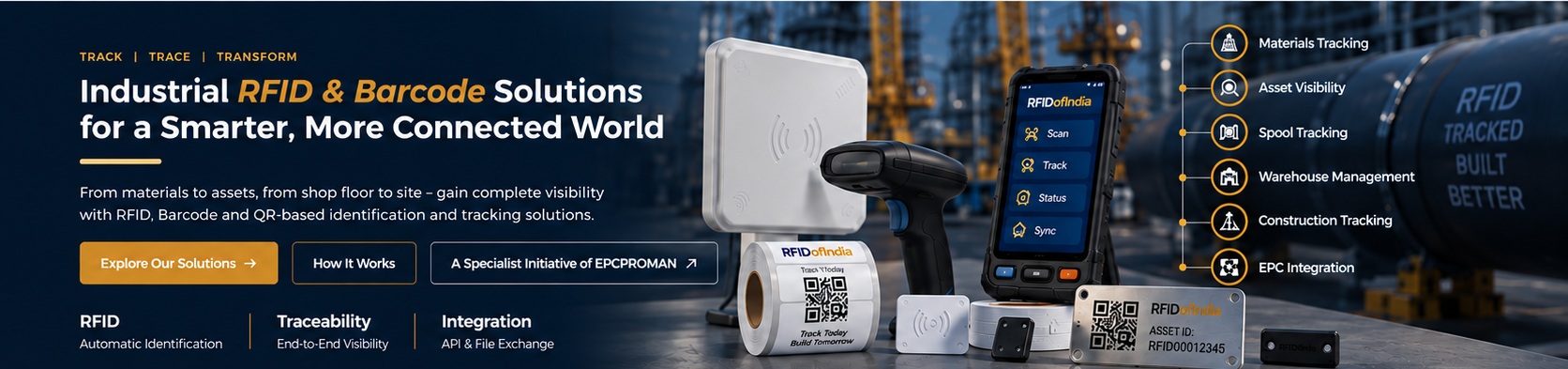
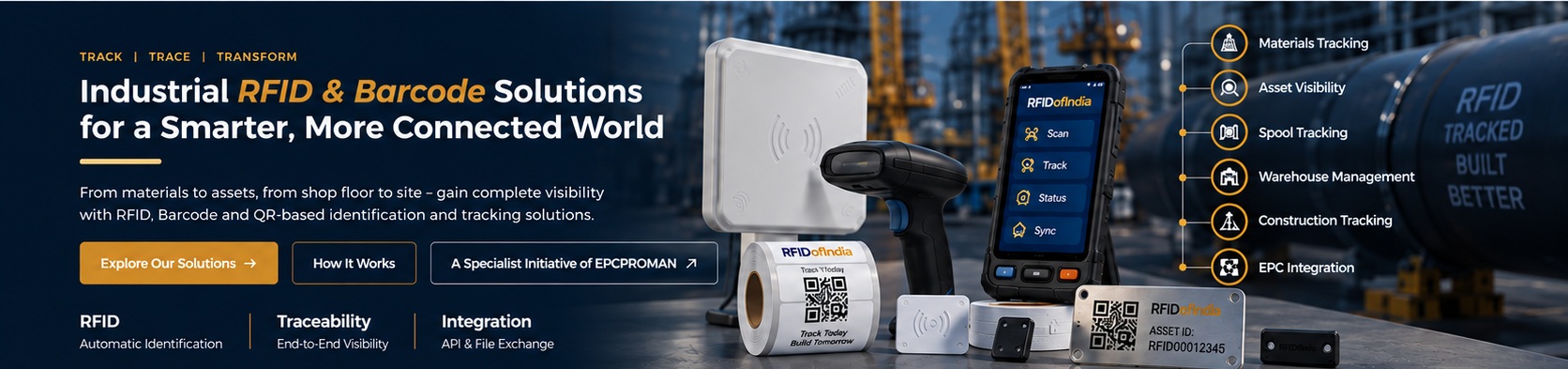
From materials to assets, from shop floor to site – gain complete visibility with RFID, Barcode and QR-based identification and tracking solutions.
RFID and Barcode transform the way industrial organizations identify, locate, move and manage physical materials and assets.
Automatically identify assets, materials and equipment using RFID, Barcode or QR.
Track movement across locations in real time — from procurement to site.
Maintain complete traceability throughout the project lifecycle.
Integrate seamlessly with EPCPROMAN, ERP, WMS and other enterprise systems.
Designed for the environments where material visibility, traceability and execution control matter most.
Track equipment, tools, containers, machinery and other reusable industrial assets across locations and workflows.
EXPLORE SOLUTION →Digitally identify pipes, fittings, valves, flanges and project materials from receiving through issue and installation.
EXPLORE SOLUTION →Track spool fabrication, inspection, painting, dispatch, site receipt and erection with a connected digital history.
EXPLORE SOLUTION →Accelerate receiving, put-away, inventory verification, material issue, returns and dispatch processes.
EXPLORE SOLUTION →Connect physical material movement with workfront, installation and project execution status.
EXPLORE SOLUTION →Build a searchable movement and status history for tagged items across the project lifecycle.
EXPLORE SOLUTION →RFID is not the answer for every process. Barcode and QR Code identification can provide a cost-effective, deliberate scanning approach — and can coexist with RFID in a hybrid tracking architecture.
Identify and scan pipes, fittings, valves, components and project materials through receiving, storage, issue and installation workflows.
MATERIAL TRACKING →Use durable barcode labels and mobile scanning for tools, equipment, containers and reusable industrial assets.
ASSET TRACKING →Enable smartphone or mobile-device identification for selected assets, documents, locations and operational workflows.
QR SOLUTIONS →Use RFID where automated or non-line-of-sight identification adds value and barcode where deliberate point scanning is more practical.
HYBRID STRATEGY →Connect handheld scanning with business workflows, status updates, search, verification and synchronized project records.
MOBILE WORKFLOWS →Bring barcode and QR events into the same application and integration framework used for RFID tracking.
INTEGRATION →Select the right identification hardware for the material, environment and workflow. RFIDofIndia brings together industrial-grade tags, readers, handheld devices, barcode printers and durable labels for EPC, Oil & Gas, Power, Manufacturing and Infrastructure projects.
Passive UHF, On-Metal, High-Temperature and application-specific tags.
MATERIAL & ASSET ID →Fixed readers, antennas, portals and read-zone configurations.
AUTOMATED CAPTURE →Mobile identification for receiving, inventory, yard and site tracking.
MOBILE TRACKING →Industrial label printing for material, asset, spool and location identification.
LABEL PRINTING →Durable, weather-resistant and customizable identification labels.
BARCODE & QR →A complete solution combines identification hardware, edge capture, application workflows and enterprise integration.
Suitable for scalable item and material identification with non-line-of-sight reading depending on application and environment.
Handheld, fixed and gateway-based readers can be selected according to the operational environment.
Create a continuous digital trail from material receipt to project installation and commissioning.
Identify and register incoming materials with RFID-assisted capture.
Locate, verify and move tagged materials across storage locations.
Associate materials and spools with fabrication and inspection workflows.
Capture status transitions and maintain traceability through production stages.
Record movement from fabrication or warehouse to the construction site.
Connect physical installation activity with project execution records.
The value of RFID is not only faster identification. It comes from connecting physical movement with reliable digital records and actionable workflows.
Capture item identity quickly and reduce repetitive manual searching and data entry.
Reduce transcription errors and strengthen the consistency of material and asset records.
Maintain a digital history of material and asset movements across defined project and operational stages.
Improve visibility of where tagged items were last identified within configured tracking zones and workflows.
Connect physical material status with project execution information for more informed decisions.
Exchange RFID events with EPC, ERP, WMS, MES and analytics systems through APIs or file-based interfaces.
The right technology depends on the operating environment, identification method, reading distance and automation requirements.
| Capability | RFID | Barcode | QR Code |
|---|---|---|---|
| Line of sight | Not always required | Generally required | Generally required |
| Multiple-item reading | Yes, depending on system design | Typically sequential | Typically sequential |
| Automation potential | Very High | High | High |
| Industrial durability | Tag dependent; rugged options available | Label dependent | Label dependent |
| Best fit | High-volume tracking & traceability | Cost-effective scanning | Low-cost digital identification |
RFID should not operate as an isolated technology. Connect identification and movement events with project, enterprise and operational systems through APIs and file-based exchange.
Build expertise before implementation. Explore technology, hardware, applications, integration and EPC-focused tracking topics.
RFID fundamentals, UHF RFID, tags, readers, antennas, read zones and industrial deployment.
RFID TECHNOLOGY →Industrial tags, handheld readers, fixed readers, antennas, portals and accessories.
HARDWARE GUIDE →Asset tracking, material tracking, inventory visibility and digital traceability.
TRACKING SOLUTIONS →Material, spool, fabrication, warehouse, construction and project traceability applications.
EPC APPLICATIONS →Barcode systems, QR identification and hybrid RFID/barcode implementation strategies.
IDENTIFICATION GUIDE →API, file exchange, middleware and connections with EPC, ERP, WMS, MES and analytics platforms.
INTEGRATION GUIDE →Technical guides and practical resources for planning and implementing industrial RFID solutions.
Understand RFID tags, readers, antennas, frequencies, read ranges and system architecture.
READ GUIDE →From use-case definition and tag selection to reader placement, integration and rollout.
READ GUIDE →Explore practical applications for material, spool, warehouse and construction tracking.
READ GUIDE →Practical answers for teams evaluating RFID for industrial tracking and traceability.
RFID, or Radio Frequency Identification, uses radio communication between tags and readers to identify tagged objects. Depending on the system, identification can occur without direct line of sight.
Typical applications include material receiving, warehouse and yard tracking, spool fabrication, inspection, dispatch, site receipt, erection and material traceability.
UHF RFID is a radio-frequency technology commonly used for longer-range automatic identification and high-volume item tracking. Actual performance depends on tag, reader, antenna, environment and installation.
Neither is universally better. RFID is useful where non-line-of-sight or automated multi-item identification is valuable; barcode remains highly effective where low-cost, deliberate point scanning is preferred.
Yes. RFID applications can exchange identification and movement events with enterprise and project systems through APIs, middleware or file-based interfaces.
Start with the object material, mounting location, required read range, temperature, exposure, attachment method and operating workflow, then validate the selected tag in the actual environment.
A future-ready content library designed around real industrial search intent — supporting technical discovery, solution evaluation and qualified enquiries.
How RFID can connect material identification, warehouse operations, fabrication, site movement and installation workflows.
ARTICLE →Key parameters including material, mounting surface, read range, environmental exposure and application design.
ARTICLE →A practical comparison of identification technologies for industrial material and asset tracking.
ARTICLE →Understand handheld versus fixed readers, antenna types, read zones and deployment considerations.
ARTICLE →Explore how tagged spools can be tracked from fabrication through inspection, dispatch, site receipt and erection.
ARTICLE →Architecture patterns for connecting RFID events with EPC, ERP, WMS, MES and analytics platforms.
ARTICLE →Need help getting started with industrial RFID? Tell us about your tracking, traceability or integration requirement.
Our RFID specialists can help define the appropriate tags, readers, antenna configuration, application workflow and integration approach.
402, Helix 3, LBS Marg,
Ghatkopar West, Mumbai – 400086,
Maharashtra, India
+91 887 923 1111
+91 (022) 25111 111 / 222
support@epcproman.com
info@epcproman.com